
Joyful in His House of Prayer - Shavuot 2025
- Zac Waller

- Jun 4, 2025
- 7 min read
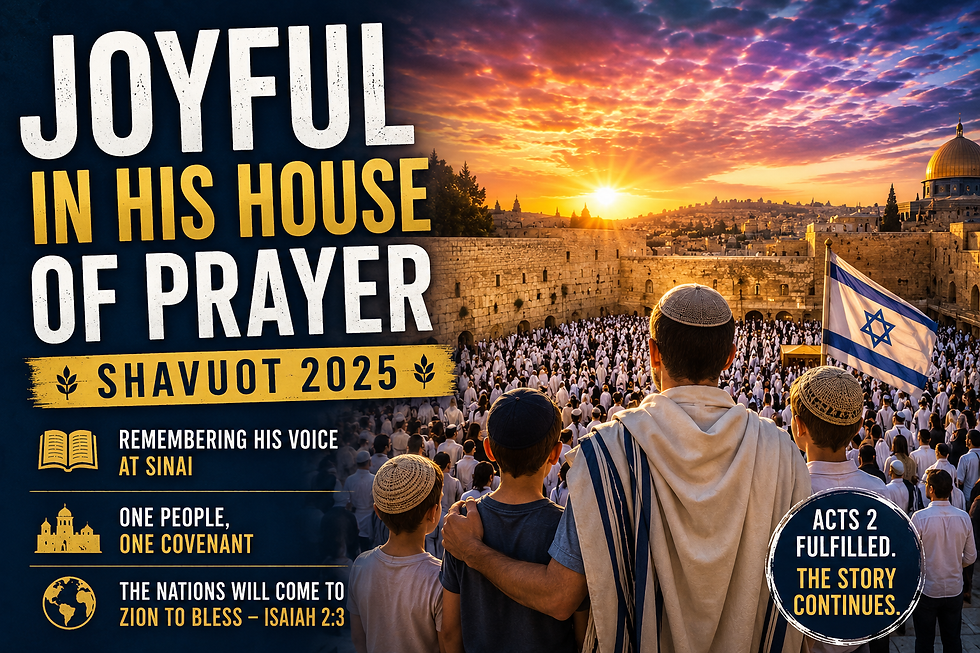
The streets of the Christian Quarter lay quiet, our footsteps brushing softly over the ancient Jerusalem stone. I had roused my four oldest boys from sleep at 4:15 AM, and now we walked in silence, winding through alleys not yet stirred by morning.
I was alert. Not afraid, but scanning. These walls have known tension, and after October 7th, everything in this land feels more vulnerable. We were guests in a quarter populated by Arab Christians, not necessarily enemies, but not always friendly either. And yet, as we passed open doors and sleeping courtyards on our way to our Airbnb the day before, I felt no hostility. Only smiles, gentle nods, and some gawking at our blond hair and blue eyes.
As we continued in the wee hours of the morning, I heard something in the distance. My first instinct was caution, should I cover the white shirt that marked me as a participant in the Jewish festival? Should I shield the boys? As we pushed slowly forward, the noise grew clearer, and suddenly they came into view as we rounded a corner. Two young Jewish men had come from the New Gate and were walking briskly down the alley, headed for the Kotel. My heartbeat turned from concern to joy as we fell in step behind them, together on our way to the Western Wall.
We are not Jewish. But we were joining the ancient flow of God’s covenant people on their way to remember His voice at Sinai, this was not foreign soil to either of us. This was holy ground. And in an Abrahamic way, we were all enveloped in His blessings.
By the time we reached Jaffa Gate, the flood had risen. Thousands were pressing into the city. People of every color, size, and sect were joyfully streaming toward Mount Zion. My boys gleefully accepted the cinnamon rolls and popsicles handed out by smiling volunteers, the sweetness of the feast mingling with the deeper hunger that brought us all here: the hunger for God’s Word. For His voice. For His house.
And then, as we passed Zion Gate, the scene before me caused my heart to soar, not like a tourist catching a view, but like a priest ascending the mountain, heart full, hands open, walking into God’s presence.
It was the most exhilarating sunrise I have ever seen. The red, purple, and blue hues, together with the architecture and the biblical enormity of the moment. And also the realization that we were walking straight into a moment that mirrored Acts two. These Jewish men and women had stayed up all night, studying Torah, waiting for the first light, just like Yeshua’s disciples. And I could feel it, that same expectant pause, that same collective holding of breath before the fire fell.
We reached the plaza. Thousands stood shoulder to shoulder, their faces lifted, their garments white, their prayers already rising. There were young mothers with babies strapped to their chests, teenagers singing passionately along with the Psalms, rabbis with weathered hands and tear-filled eyes. It wasn’t uniform, it was beautifully varied. And yet they were one.
I opened the Scriptures with my boys and read aloud. We stood together and prayed the Amidah with our Jewish brothers. And as I looked out over the crowd, I realized that I wasn’t just observing. I was in. We weren’t doing exactly the same things as they were, and we look and talk a lot differently. But we belonged. The kind of belonging that only exists when you glimpse something eternal and realize, this is what I was made for. These are the people of God. This is His rhythm. This is His holiness. I have found my role under this banner and am walking in it, not only for me, but for my sons, and their sons after them.
A pastor and his son, the only other Christians we saw, came over with a smile and said quietly, “This is something sacred. You can feel it.” I nodded in complete agreement. I leaned over to my son and said, “Years from now, we will say, ‘I remember when we were the only Christians who would come to the Shavuot morning prayers. Now, thousands are coming to join.’ The only issue is that there isn't enough room. We will have to have the Temple Mount open by then!”
There we were together tasting the very thing God promised through Abraham and Isaiah, that one day, the nations would come up to Zion, not to destroy, but to bless. Not to replace, but to join. Not to observe from afar, but to come near. To see and be seen. To be Joyful in God’s house of prayer.
The sun crested over the Mount of Olives as the last shadows stretched themselves thin across the stone plaza. We had found a place to stand near the back of the men’s section, just close enough to join in but not intrude.
My boys were quiet. Not restless, not bored, just taking it in. Their eyes moved slowly from tallit to Torah scroll, from the bowed backs of the elderly to the zeal of boys their own age, singing with all their might.
I looked down at my boys. And then out across the crowd. And my heart said it quietly, like a vow: I want them to know this story. To carry it. To live it. Not just as observers, but as participants in God’s redemptive arc, from Abraham to Sinai to Zion to the ends of the earth.
The prophets, Ezekiel, Isaiah, and Zechariah, all saw this. A day when the nations would flow to Jerusalem not to dominate her, not to convert her, but to be taught by her. To join her rejoicing. To walk in her ways. And here we were, father and his sons, Gentiles grafted in, not demanding a place, just walking gratefully in the one we’ve been given.
As we turned to leave, I looked back one more time. I needed to remember. I wanted to mark it in my soul, this moment of peace in a city that has known too much war. From there, we made our way to the Temple Mount line. It was a long wait, several hundred Jews clustered in the early heat, visibly restless. And who could blame them? They had risen early, dressed in white, gathered their families, only to be stalled, delayed, told again and again: “Wait your turn.” The Israeli police, under pressure from the Waqf, were allowing them to ascend only in small, measured groups. You could feel the frustration pressing against the barricades.
But it wasn’t anger. Not violence. It was longing. The kind of longing that builds when a people has been exiled from their most intimate, holy, honored space. The kind that refuses to be extinguished.
I scanned the crowd. Rabbi Yehuda Glick had arrived and was making his way through security. Tall and steady, his face a mixture of resolve and joy. Around him were familiar faces, men who have labored in prayer, suffered threats, endured slander, all for the simple, biblical dream of walking freely on God’s holy hill.
As I stood there, a teaching echoed in my heart, one I’d heard just days before from Rabbi Pesach Wolicki. Every civilization builds monuments to its values. Egypt built pyramids. Their culture revolved around death. Even their most famous book is named “The Book of the Dead.” Europe? Grand cathedrals, towering stone tributes to the all-powerful Pope.
Communist nations built palaces for the party elite, cement fortresses of power and control. America? Massive sports stadiums and shopping malls, because our god is pleasure, entertainment, and excess.
But Israel? Israel is called to build a house for God. A House of Prayer for all nations. A place where heaven touches earth. A place where every knee, Jewish or Gentile, might bow and say, “He alone is holy.” Though the Temple is not yet rebuilt, and the stones have not yet been raised again, I stood there as a Gentile, not just observing, but participating in its holiness. Not excluded, but welcomed.
At last, the security ushered us onto the ramp. We ascended with a group of Jewish men led by Rabbi Glick. Immediately, several men began to sing with great jubilation, “Let the Temple be rebuilt, the city of Zion repopulated, that we may come up singing a new song.” As the song quieted, Rabbi Glick’s powerful voice rang out from the ramp down towards the people praying at the wall. “This wall is a golden calf! Why do you stay here and pray at the fake monument when you can go up to the Mountain of God? You who are for HaShem, come with me! Come, let us go up to Zion!”
We made our way through the Hallel gate. Everyone was talking Torah or singing praises. When we arrived at the east wall, we all fell on our faces towards God’s house. Just before the Golden Gate, Rabbi Glick began the morning prayers. The sweet melodies of song drifted over the courtyard, reminiscent of earlier times when the Levitical choir would lead the nation in worship.
Completing the loop around the holy Mount, we turned to face the Foundation stone and walked backwards. As we exited the gate, several of the men joined hands, sang, and danced.
And then, still beaming, we ran. Down the alleys, through the sun-soaked streets, back toward the apartment. I knew what waited on the table: Becca’s special hot, golden cheese blintzes!
I write this now, days later, with the dust of Jerusalem still clinging to our shoes and ancient prayers still echoing in our hearts. And I say to you, wherever you are, whatever your story, this is your inheritance too.
You were grafted in not to replace Israel, but to bless her. You were called not to observe from the outer courts, but to draw near. You were chosen to love what God loves, to honor what He calls holy, to bring your sons, your daughters, your prayers, and your praise up to Jerusalem.
So let’s walk in that ancient rhythm. Let’s take our place in the story. Let’s go up to Zion, again and again, with hearts full and eyes open.


Beautifully written and expressed, I felt almost as if I were there. I have been there with your team. I hope to be there again someday. Shalom!
Beautifully expressed! The blessings of grafted in.